
Red Clover
A productive short-lived perennial legume valued for pasture, hay, soil improvement, biological nitrogen fixation and pollinator habitat. Red Clover provides vigorous forage growth and fits well in grass-legume mixtures throughout cool-season production systems.
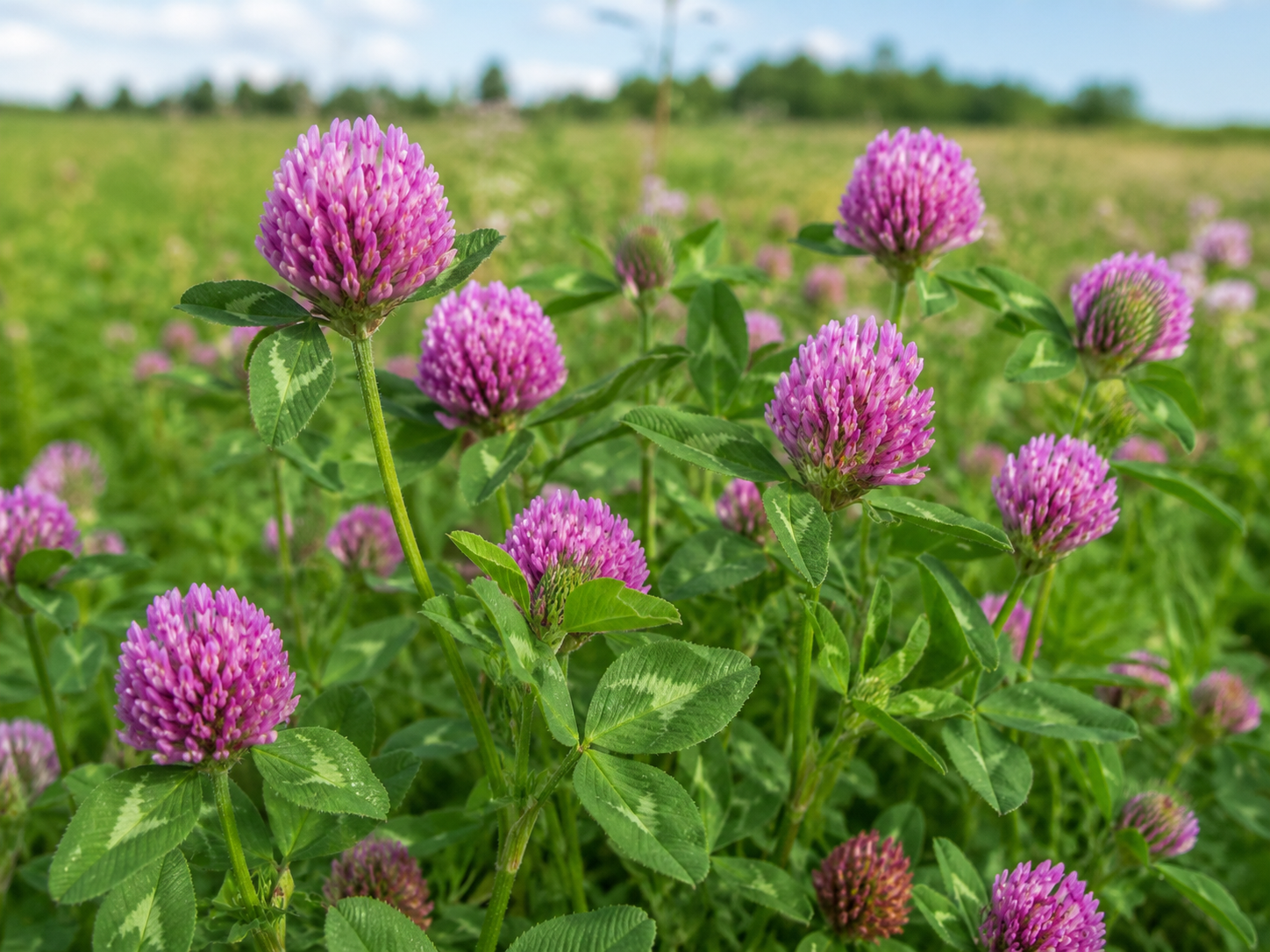
Productive Clover for Forage & Soil Improvement
Red Clover is a vigorous forage legume commonly used in pasture, hay, cover crop and soil-improvement systems. Unlike many annual clovers, Red Clover can persist for multiple growing seasons under favorable conditions.
It develops an upright, leafy canopy and produces distinctive pink-to-red flower heads that are highly attractive to pollinating insects.
When effectively inoculated and successfully nodulated, Red Clover can biologically fix atmospheric nitrogen and contribute nitrogen-rich plant material to the production system.
Why Red Clover?
Red Clover occupies a useful middle ground between annual clovers and long-lived perennial legumes such as alfalfa.
It provides productive forage and nitrogen fixation without requiring the long-term commitment of a permanent perennial legume stand.
What Red Clover Brings to the Field
Nitrogen Fixation
Properly inoculated and nodulated Red Clover can biologically fix atmospheric nitrogen and contribute nitrogen-rich legume biomass.
High-Quality Forage
Leafy vegetative growth makes Red Clover a valuable component of pasture, hay and mixed-forage systems.
Multiple-Year Potential
Red Clover commonly behaves as a short-lived perennial, allowing productive stands to persist beyond a single season where conditions and management are favorable.
Pollinator Value
Dense flower heads provide useful nectar and pollen resources for bees and other pollinating insects.
Grass Compatibility
Red Clover combines well with cool-season pasture grasses to improve stand diversity and forage quality.
Soil Building
Root growth, living cover and legume residue contribute organic material and biological activity to the soil.
Where Red Clover Fits
Pasture
Adds productive legume forage and nitrogen fixation to compatible cool-season grass pastures.
Hay
Produces leafy forage suitable for mixed or legume-dominant hay systems under appropriate management.
Cover Crops
Can provide longer-duration living cover and nitrogen-fixing legume growth where a multi-season stand is acceptable.
Pollinator Habitat
Abundant flowering can provide a valuable food source for bees and other beneficial insects.
Red Clover Planting Information
Red Clover has relatively small seed and should be planted shallowly into a firm seedbed. Consistent seed placement, adequate moisture and good seed-to-soil contact support uniform establishment.
Seeding rates are general guidelines for pure stands. Adjust the rate for seed quality, planting method, field conditions, intended use and whether Red Clover is planted alone or within a pasture or cover crop mixture.
Red Clover commonly persists for approximately two to three years under favorable growing conditions, making it useful where more than one season of legume production is desirable.
Stand life depends heavily on drainage, disease pressure, grazing or cutting management and environmental conditions.
Strong Partner for Cool-Season Pasture Grasses
Red Clover can improve the diversity and forage value of grass-based pasture systems while contributing biological nitrogen fixation.
Orchardgrass
A strong pasture and hay companion that provides productive cool-season grass forage.
Tall Fescue
Adds persistent grass growth and complements Red Clover in diversified pasture stands.
Timothy
Provides another cool-season forage grass option for mixed hay and pasture systems.
Perennial Ryegrass
Adds dense, palatable cool-season grass growth to Red Clover pasture mixtures.
Manage Red Clover for Persistence & Forage Quality
Use Compatible Clover Inoculation
Effective biological nitrogen fixation depends on compatible rhizobia and successful root nodulation. Use an appropriate Red Clover inoculant where compatible bacteria are not already established.
Prioritize Good Drainage
Red Clover performs best on reasonably well-drained soils and is not well suited to prolonged flooding or waterlogged conditions.
Manage Grazing Pressure
Avoid repeatedly grazing plants excessively short. Allowing adequate recovery helps maintain productive crowns and improves stand persistence.
Manage as a Legume Forage
Red Clover is a high-quality legume forage. Livestock grazing programs should account for normal legume-associated bloat risk and maintain appropriate forage balance.
Need Red Clover Seed?
Contact Weaver Seed for current Red Clover availability, wholesale pricing, pasture mixtures, custom cover crops and help determining the appropriate seeding rate for your operation.
Contact Weaver Seed