
Faba Beans
A vigorous cool-season annual legume valued for nitrogen fixation, substantial biomass production and deep-rooted growth. Faba beans are well suited to cover crop programs, green manure applications and diversified agricultural seed mixtures.
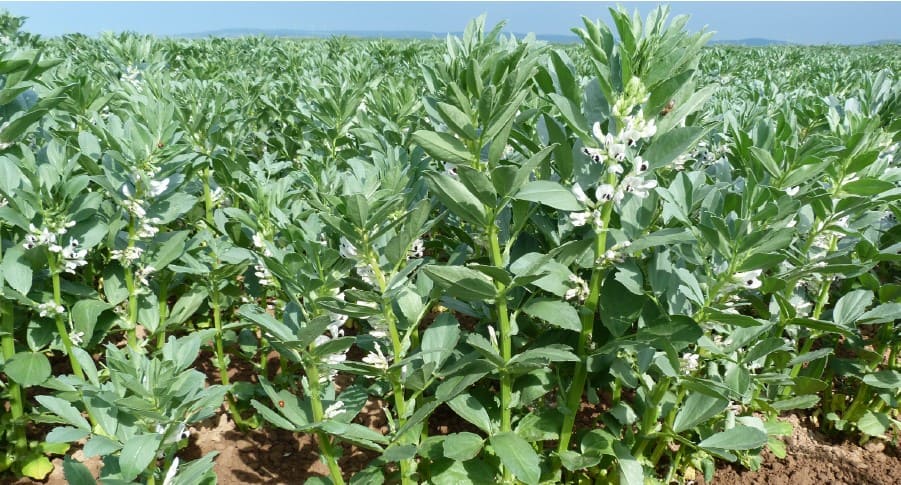
High-Biomass Cool-Season Legume
Faba beans, also commonly called fava beans or bell beans, are upright-growing annual legumes used extensively in California cover crop and green manure systems.
Their vigorous growth, large amount of vegetative material and ability to biologically fix atmospheric nitrogen make faba beans particularly useful where growers want to build legume biomass during the cool season.
Faba beans can be planted as a pure stand or combined with other legumes and cereal grains to create more diverse winter cover crop mixtures.
Why Use Faba Beans?
Faba beans combine an upright growth habit with a substantial root system and heavy above-ground biomass production.
When properly inoculated and effectively nodulated, they can fix atmospheric nitrogen and incorporate that nitrogen into their plant biomass.
What Faba Beans Bring to a Cover Crop
Nitrogen Fixation
Properly inoculated faba beans can biologically fix atmospheric nitrogen and build nitrogen-rich legume biomass.
High Biomass
Large plants and vigorous cool-season growth can produce substantial residue for green manure and soil-building programs.
Deep Rooting
Strong rooting allows faba beans to explore the soil profile and makes them useful where improving soil structure is a goal.
Soil Improvement
Large amounts of plant material can contribute organic residue to the soil following termination.
Cool-Season Growth
Well suited to fall planting and winter cover crop programs across many California agricultural areas.
Beneficial Insect Value
Flowers can provide resources for pollinators and other beneficial insects when plants are allowed to reach bloom.
Where Faba Beans Fit
Orchards
Useful as a winter annual legume where biomass and nitrogen contribution are primary cover crop objectives.
Vineyards
Can serve as a substantial legume component in cultivated vineyard middles and winter cover crop programs.
Green Manure
High biomass production makes faba beans well suited to systems where the cover crop will be terminated and returned to the soil.
Custom Mixes
Combines well with peas, vetches and cereal grains in diversified cool-season cover crop mixtures.
Faba Bean Planting Information
Establish into a prepared seedbed with adequate soil moisture and good seed-to-soil contact. Faba beans have relatively large seed, so proper seed placement is particularly important.
Seeding rates are general guidelines. Faba bean seed size can vary substantially among varieties and seed lots. Intended use, planting method, row spacing, seedbed conditions and desired stand density should be considered when determining the final rate.
Faba beans are often selected for nitrogen production, but their large plants and substantial root growth make them valuable for broader soil-improvement programs as well.
Build a Balanced Winter Cover Crop
Faba beans provide the large-seeded legume component in many traditional California cover crop combinations.
Common Vetch
Adds additional vining legume growth and diversity.
Forage Peas
Complements faba beans with productive cool-season legume growth.
Oats
Adds fibrous-rooted cereal biomass and structural diversity.
Triticale
Adds vigorous cereal growth, residue and root mass.
Establish for the Goal
Consider Proper Inoculation
If nitrogen fixation is a primary goal, appropriate rhizobial inoculation should be considered where compatible bacteria are not already established in the soil.
Know Your Rotation
Like any cover crop species, faba beans should be selected with the following cash crop, field pest history and termination timing in mind rather than being treated as a universal solution.
Need Faba Bean Seed?
Contact Weaver Seed for current availability, wholesale pricing, custom cover crop mixtures and assistance selecting the appropriate seeding rate for your operation.
Contact Weaver Seed