
Dundale Peas
A productive field pea used for cool-season forage, cover crops, green manure and diversified seed mixtures. Dundale provides vigorous leafy growth, nitrogen-fixing potential and valuable legume biomass for Western agricultural systems.
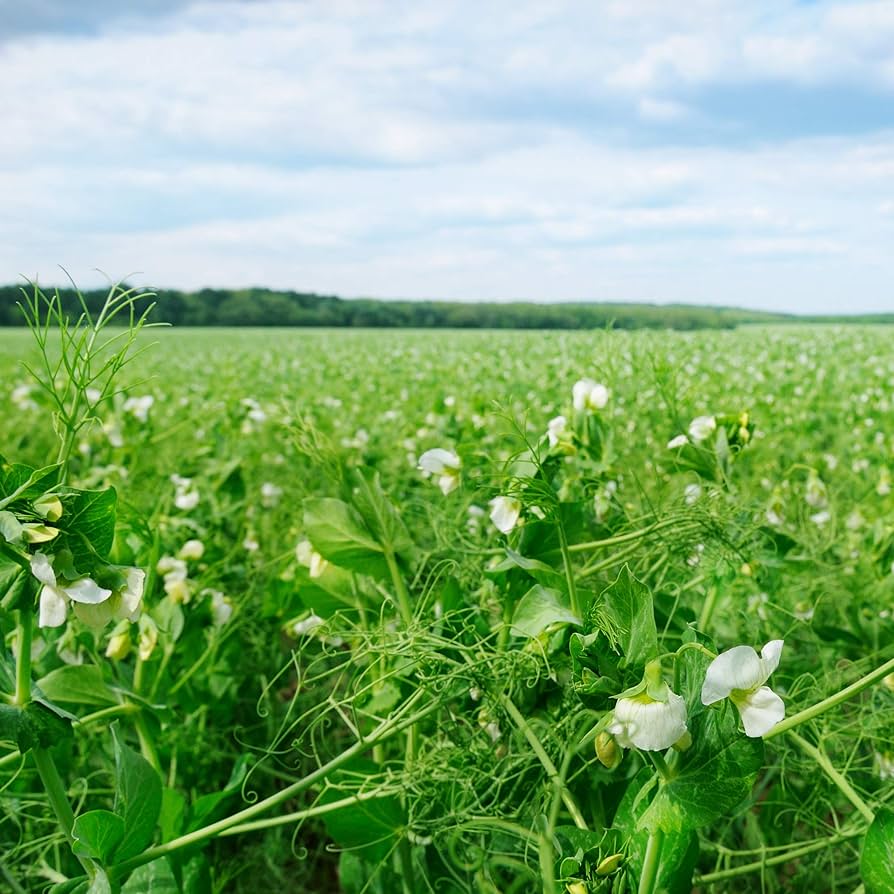
Productive Field Pea for Forage & Soil Building
Dundale is a conventional-leaf field pea with a leafy, vining growth habit. It can produce substantial cool-season vegetative growth and is particularly useful in forage, green-manure and cover crop programs.
Like other field peas, Dundale can biologically fix atmospheric nitrogen when effectively inoculated and successfully nodulated. The resulting legume biomass can contribute nitrogen-rich plant material to the cropping system.
Dundale may be planted alone, but its climbing growth habit makes it especially well suited to mixtures with oats, triticale, barley and other upright cereal grains.
Why Plant Dundale?
Dundale combines productive legume growth with strong forage and cover crop utility. Its leafy vines contribute valuable biomass while cereal companions can provide support for the pea canopy.
This makes Dundale particularly useful where growers want both a legume component and substantial cool-season plant growth in the same system.
What Dundale Peas Bring to the Field
Nitrogen Fixation
Properly inoculated and nodulated Dundale peas can biologically fix atmospheric nitrogen and accumulate nitrogen in their plant biomass.
Forage Production
Leafy vegetative growth makes field peas valuable as a legume component in annual forage mixtures.
Cover Crop Biomass
Productive seasonal growth contributes plant residue for green-manure and soil-building programs.
Cereal Compatibility
Dundale's vining growth can use oats, triticale and other upright cereals for physical support.
Mixture Diversity
Adds broadleaf legume growth to cereal-dominated cover crop and forage mixtures.
Green Manure
Can be grown specifically to produce legume biomass for mowing, incorporation or another planned termination method.
Where Dundale Peas Fit
Forage Mixes
Adds a leafy legume component to annual cereal forage mixtures for improved diversity and forage value.
Cover Crops
Provides seasonal legume growth, soil cover and nitrogen-fixing potential in cool-season programs.
Green Manure
Useful where the objective is to produce legume biomass that will be terminated and returned to the cropping system.
Custom Mixes
Combines well with small grains and other compatible cool-season species in diversified seed mixtures.
Dundale Pea Planting Information
Dundale peas perform best when planted into a firm seedbed with adequate moisture and consistent seed placement. Planting depth should be adjusted as needed to place seed into moisture without planting unnecessarily deep.
Rates are general Weaver Seed guidelines. Actual rate should be adjusted for seed size, germination, planting method, field conditions, planting date, desired stand density and whether Dundale is being planted alone or in a mixture.
Dundale is a conventional-leaf field pea rather than a modern semi-leafless type. Its stems and tendrils develop a vining canopy that can lodge when grown alone under productive conditions.
Pairing Dundale with upright cereal grains can help support the pea canopy while simultaneously adding fibrous roots and additional forage or cover crop biomass.
Pair Dundale With Upright Cereal Grains
Cereal grains complement Dundale particularly well because they provide structural support while contributing fibrous roots and additional biomass.
Oats
A classic companion for field peas, providing upright support, forage biomass and fibrous root growth.
Triticale
Adds vigorous cereal growth and strong structural support to forage and cover crop mixtures.
Barley
Provides fast cool-season cereal establishment and an upright canopy for climbing pea growth.
Wheat
Adds another upright cereal option for diversified forage and soil-building mixtures.
Get More From the Stand
Use Appropriate Pea/Vetch Inoculation
Where compatible rhizobia are not already established, use an appropriate pea/vetch inoculant when biological nitrogen fixation is an important objective.
Avoid Prolonged Waterlogging
Field peas perform best in reasonably well-drained soil. Prolonged saturated or waterlogged conditions can reduce establishment and overall crop performance.
Need Dundale Peas?
Contact Weaver Seed for current availability, wholesale pricing, forage mixtures, custom cover crops and help determining the appropriate Dundale Pea seeding rate for your operation.
Contact Weaver Seed