
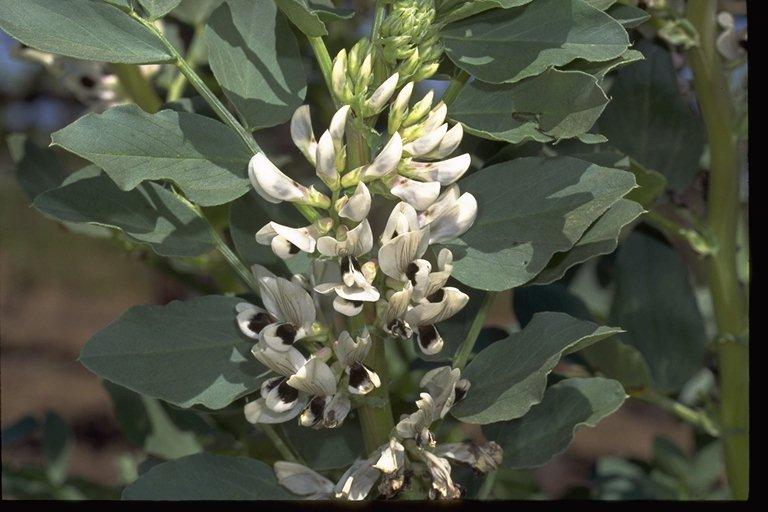
Bell Beans
Bell Beans are a large-seeded annual legume commonly used in California cover crop systems for biomass production, biological nitrogen fixation and forage value. They can be planted alone or incorporated into multi-species mixes with cereals, peas, vetches and other compatible cover crop species.
Why Plant Bell Beans?
Bell Beans combine large-seeded establishment, substantial above-ground growth and legume nitrogen fixation, making them useful in both simple and high-diversity cover crop systems.
Nitrogen Fixation
When properly inoculated and nodulated, Bell Beans can biologically fix atmospheric nitrogen and contribute nitrogen-rich plant residue to the cropping system.
High Biomass Potential
Bell Beans can produce substantial vegetative growth under favorable fertility, moisture and growing conditions.
Large Seed
Their large seed allows deeper placement than small-seeded clovers and can support strong seedling emergence from a properly prepared seedbed.
Forage Value
Bell Beans can contribute protein-rich legume forage when incorporated into appropriately managed livestock systems.
Cover Crop Diversity
Bell Beans combine well with compatible cereals and other legumes to add another rooting pattern and growth habit to multi-species cover crop blends.
Perennial Crop Systems
Frequently used as part of winter cover crop mixtures in vineyards and orchards where biomass and legume diversity are desired.
Planting Bell Beans
Weaver Seed's current working rate is approximately 80 lb per acre when drilled and 100 lb per acre when broadcast.
Bell Beans are relatively large seeded and can be planted deeper than small-seeded legumes. A planting depth of up to approximately 2 inches can be used depending on soil texture and moisture conditions.
When broadcasting, incorporation or packing can improve seed-to-soil contact. Planting rates should be reduced appropriately when Bell Beans are one component of a multi-species cover crop mixture.
Seeding Rate Note: Actual seeding rate may vary with seed size, seed lot, planting method, field conditions and whether Bell Beans are planted alone or within a mixture.
Best Uses for Bell Beans
Cover Crops
Strong fit for cool-season cover crop systems where biomass and legume nitrogen fixation are priorities.
Orchards & Vineyards
Can be incorporated into compatible winter cover crop mixes between perennial crop rows.
Forage Mixtures
Adds a large-seeded, protein-producing legume component to suitable forage mixtures.
Soil-Building Mixes
Useful in high-diversity blends where additional biomass, root diversity and legume function are desired.
Manage Bell Beans Around Your Crop Goal
Management timing should reflect whether Bell Beans are being grown primarily for nitrogen, biomass, forage or as one component of a diverse cover crop stand.
Support Nodulation
Use the appropriate rhizobial inoculant when needed to support effective nodulation and nitrogen fixation.
Maintain Moisture
Adequate soil moisture during germination and early growth supports strong stand establishment.
Time for Your Goal
Termination timing should balance biomass production, nitrogen objectives, soil moisture and the needs of the following crop.
Adjust Component Rate
Use less than the full-stand rate when Bell Beans are combined with cereals, peas, vetches or other cover crop species.
Perennial Crop Note: In orchards and vineyards, monitor cover crop growth and soil moisture so vigorous biomass production does not create unwanted competition with the permanent crop.
Looking for Bell Bean Seed?
Contact Weaver Seed for current Bell Bean availability, quantities, pricing or help incorporating Bell Beans into a cover crop, forage or custom seed mixture.
Request Pricing